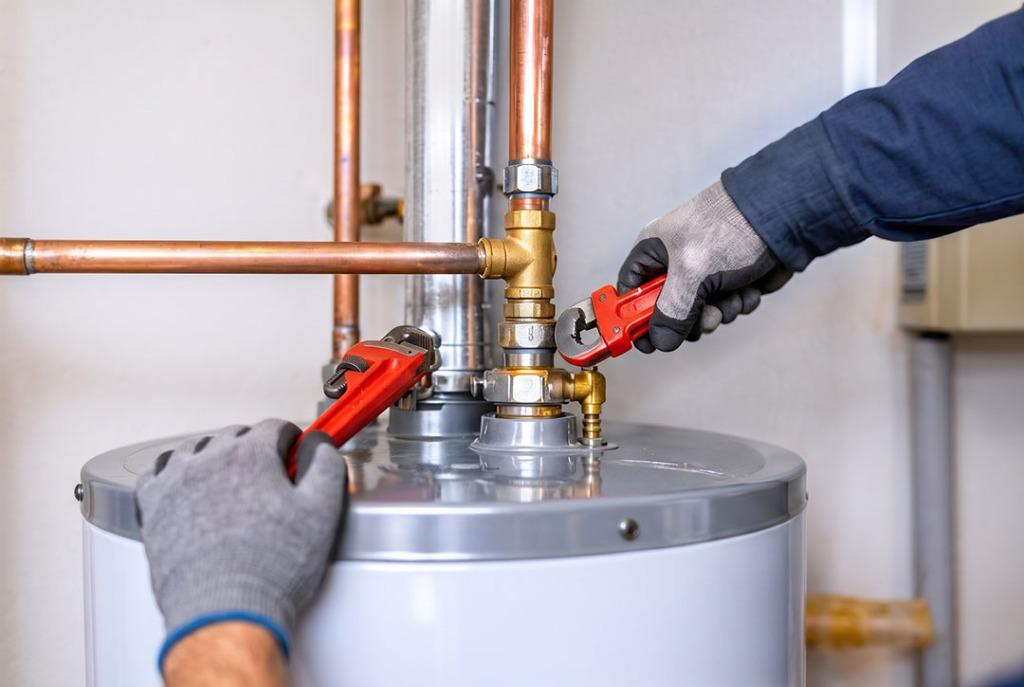
How Altitude (5,280 ft) Impacts Gas Water Heater Combustion and Venting
If you purchase a gas water heater off the shelf at a home improvement warehouse in the Midwest or along the coast, it is calibrated to operate in dense sea-level air. Bring that exact same unit to Denver, Colorado—sitting precisely 5,280 feet above sea level—and install it without high-altitude modifications, and you create an appliance that burns inefficiently, produces soot, and can release lethal levels of carbon monoxide into your living space.
Understanding how Colorado's elevation affects natural gas combustion is essential for every homeowner. In this guide, our network of licensed master plumbers explains the science of high-altitude heating, municipal code requirements, and how to verify that your gas water heater is operating safely.
The Science of Thin Air: Less Oxygen per Cubic Foot
Combustion is a chemical reaction between natural gas (methane, $ ext{CH}_4$) and oxygen ($ ext{O}_2$). For natural gas to burn cleanly and produce harmless water vapor and carbon dioxide ($ ext{CO}_2$), it requires a precise stoichiometric air-to-fuel ratio of approximately **10 parts air to 1 part gas**.
$$ ext{CH}_4 + 2 ext{O}_2 ightarrow ext{CO}_2 + 2 ext{H}_2 ext{O} + ext{Heat}$$
At sea level, atmospheric pressure is roughly 14.7 pounds per square inch (PSI). At 5,280 feet in Denver, atmospheric pressure drops to approximately **12.2 PSI**.
Because air molecules are spread further apart, every cubic foot of air in Denver contains approximately **17% to 20% less oxygen** by weight than air at sea level. In elevated suburbs like [Highlands Ranch](/service-areas/highlands-ranch/) and [Centennial](/service-areas/centennial/) (nearly 6,000 feet), the oxygen reduction is even greater.
What Happens When a Water Heater Gets Too Little Oxygen?
If a water heater delivers standard sea-level quantities of natural gas into thin mountain air, the burner becomes "fuel-rich" (starved for oxygen). This triggers **incomplete combustion**:
$$ ext{Incomplete Combustion: } 2 ext{CH}_4 + 3 ext{O}_2 ightarrow 2 ext{CO (Carbon Monoxide)} + 4 ext{H}_2 ext{O}$$
The Hazards of Incomplete Combustion: 1. **Carbon Monoxide (CO) Generation**: The burner produces toxic, colorless, odorless carbon monoxide gas instead of safe carbon dioxide. 2. **Soot Accumulation**: Carbon builds up as dense black soot across the burner manifold, thermocouple, and internal flue baffle, restricting airflow further. 3. **Flame Rollout**: Flames reach out of the combustion chamber searching for oxygen, melting wiring, scorching insulation, and tripping thermal safety switches. 4. **Yellow Lazy Flame**: Instead of a crisp, sharp blue cone, the burner burns with a floppy, yellow/orange flame.
The 4% Rule: High-Altitude Derating
To restore the proper 10:1 air-to-fuel balance in Denver, licensed plumbers must **derate** the gas water heater.
According to National Fuel Gas Code (NFPA 54) and International Fuel Gas Code (IFGC) enforced throughout Colorado: > *For appliances operating above 2,000 feet elevation, fuel input must be reduced at the rate of **4% for every 1,000 feet** above sea level.*
At Denver's elevation of 5,280 feet: - Elevation correction factor: $5.28 imes 4% approx mathbf{21% ext{ derate}}$. - A water heater rated at 40,000 BTUs at sea level is properly derated to approximately **31,600 BTUs** in Denver.
How Plumbers Derate Water Heaters Plumbers accomplish this by installing a factory-certified high-altitude main burner orifice with a smaller drill diameter, or by recalibrating the manifold pressure regulator on the gas control valve using a digital manometer.
Venting and Draft Challenges Along the Front Range
Derating the burner is only half the battle; the exhaust must also escape safely through the flue.
Standard atmospheric water heaters rely on **gravity draft**: hot exhaust gases are lighter than surrounding air and naturally rise up a metal B-vent chimney pipe. However, in Colorado, two factors frequently disrupt natural draft:
1. Tight Building Envelopes Modern Denver homes are tightly air-sealed with high-efficiency windows, spray foam insulation, and powerful kitchen range hoods that exhaust 400 to 1,200 CFM of air outdoors. When a powerful kitchen vent or bathroom fan runs, it pulls a negative pressure vacuum in the basement, pulling water heater exhaust *backward* down the chimney into your home (backdrafting).
2. High-Wind Foothill Downdrafts Neighborhoods in [Arvada](/service-areas/arvada/), [Lakewood](/service-areas/lakewood/), and [Littleton](/service-areas/littleton/) frequently experience severe Chinook winds cascading down the foothills at 50+ mph. These turbulent wind currents can push down chimneys, blowing out pilot lights and spilling flue gas into basements.
How to Test If Your Water Heater Is Backdrafting
You can perform a simple preliminary check using a stick of incense or a smoke pencil:
- Close all exterior windows and doors. Turn on your kitchen range hood and bathroom exhaust fans on high.
- Run a hot water shower until the water heater burner fires up at full capacity.
- Wait 2 minutes for the flue pipe to warm up and establish draft.
- Hold the smoking incense stick 1 inch away from the lip of the draft hood (the bell-shaped metal opening on top of the water heater).
- **Normal Draft**: The smoke should be strongly drawn up into the flue pipe.
- **Backdrafting Hazard**: If the smoke is blown back into the room or curls outward, toxic exhaust is spilling into your home. Shut off the heater and call for professional inspection immediately.
The Modern Solution: Power-Vent and Direct-Vent Tankless Units
Because atmospheric B-vents struggle with tight construction and Front Range winds, many Denver homeowners are replacing atmospheric tanks with **Power-Vent tanks** or **Direct-Vent Tankless systems**: - **Sealed Combustion**: They draw 100% of their combustion air directly from outdoors via dedicated PVC intake pipes. - **Mechanical Exhaust Blower**: An integrated fan pushes exhaust gases safely out through exterior walls, rendering the system impervious to atmospheric pressure drops or wind gusts.
Explore our [Tankless Water Heater Installation](/tankless-water-heater-installation-denver/) options to learn more about sealed-combustion systems.
Carbon Monoxide Safety Guidelines
Every home in Colorado with gas appliances is required by state law (the Colorado Carbon Monoxide Safety Act) to maintain operational carbon monoxide alarms within 15 feet of every sleeping room. Test your alarms monthly and replace detectors every 5 to 7 years.
If you suspect combustion issues, delayed ignition, or venting problems with your gas water heater, call **(456) 789-0123** for expert diagnosis by a certified Colorado plumbing technician.
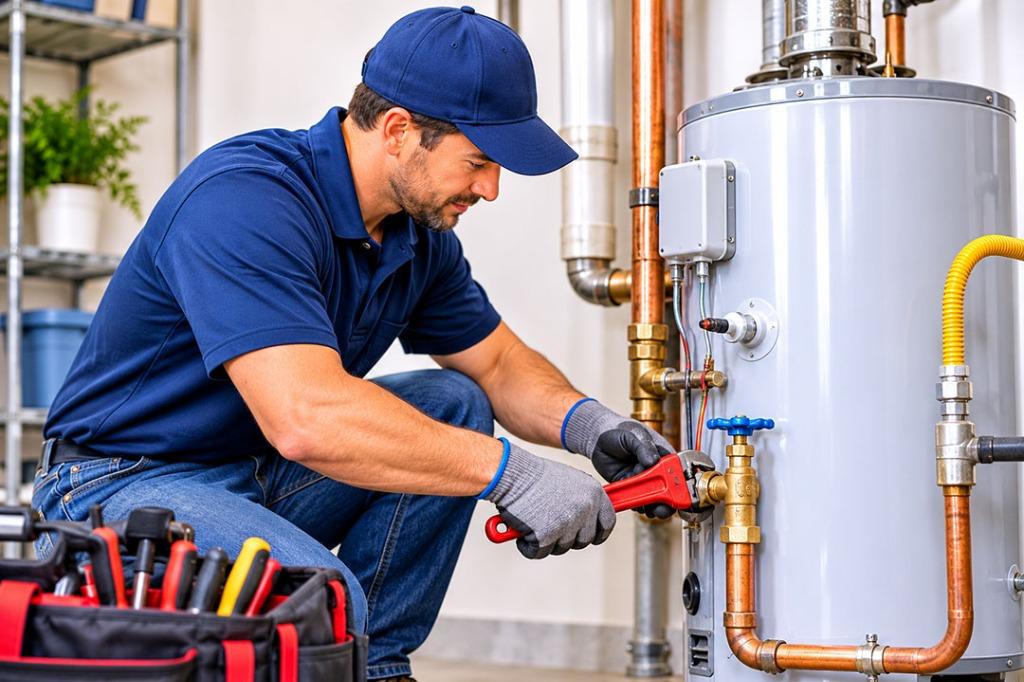
On-Site Field Testing & Diagnostic Standards
Denver plumbers verify water pressure, high-altitude gas combustion ratios, and electrical continuity before recommending part replacements. If you suspect your water heater is failing, call for an immediate on-site inspection.