Denver Water Quality & How Mineral Sediment Destroys Water Heaters
Denver is famous for its crisp, pristine mountain runoff. Our drinking water originates primarily from pure winter snowpack collected in the high Rocky Mountains, channeled through reservoirs including Dillon, Gross, and Strontia Springs before treatment by Denver Water.
While Denver water tastes clean and is safe to drink, its journey through mountain streams and limestone deposits introduces dissolved mineral carbonates. When this water enters your home and is heated to 120°F–140°F, chemical reactions take place that can quietly cut the operating life of your water heater in half.
In this deep-dive article, we examine the chemistry of Denver metro water hardness, compare mineral levels across suburbs like [Aurora](/service-areas/aurora/), [Centennial](/service-areas/centennial/), and [Highlands Ranch](/service-areas/highlands-ranch/), and explore proven ways to protect your water heating equipment.
Measuring Water Hardness: Grains Per Gallon (GPG)
Water hardness is measured in either **parts per million (ppm)** / **milligrams per liter (mg/L)** or **grains per gallon (GPG)**:
$$ ext{1 GPG} approx 17.1 ext{ mg/L (ppm)}$$
According to the Water Quality Association (WQA), water is classified as follows: - **Soft**: Less than 1.0 GPG (< 17.1 mg/L) - **Slightly Hard**: 1.0 – 3.5 GPG (17.1 – 60 mg/L) - **Moderately Hard**: 3.5 – 7.0 GPG (60 – 120 mg/L) - **Hard**: 7.0 – 10.5 GPG (120 – 180 mg/L) - **Very Hard**: Over 10.5 GPG (> 180 mg/L)
Where Does Denver Metro Water Rank? In central Denver, water hardness typically fluctuates between **3.5 and 7.5 GPG (60 to 130 mg/L)**, placing it firmly in the **moderately hard to hard** category. However, in eastern Aurora, southern Centennial, and Douglas County (Highlands Ranch), where alluvial groundwater wells supplement mountain surface runoff, hardness levels can exceed **8.5 to 11.0 GPG**.
What Happens When Hard Water Is Heated?
Calcium and magnesium ions are dissolved in cold water as calcium bicarbonate:
Ca(HCO3)2 + Heat -> CaCO3 (solid scale) + CO2 (gas) + H2O
When water is heated above 120°F inside your water heater, the soluble bicarbonate breaks down, forming solid **calcium carbonate ($ ext{CaCO}_3$)**, also known as calcite or limestone scale.
This mineral scale does not dissolve back into the water. Instead, it forms a rock-like crust that adheres to hot surfaces: 1. **On Gas Storage Tanks**: It coats the bottom tank head, acting as an insulating layer between the gas burner flame and the water. 2. **On Electric Water Heaters**: It encapsulates the copper or Incoloy lower heating element in a hard shell, driving up element temperatures until the metal sheath melts and shorts out. 3. **On Tankless Water Heaters**: It coats the micro-fins of the primary copper heat exchanger, choking water flow and triggering overheat fault codes (e.g., Navien E016 / Rinnai Code 14).
The True Cost of Mineral Sediment
A study by the Gas Appliance Manufacturers Association (GAMA) demonstrated that just **1/4-inch of mineral scale buildup** reduces water heater efficiency by **over 25%**.
For a Denver homeowner, that means: - You spend 25% more on natural gas or electricity every month to heat domestic water. - Recovery time doubles: waiting for hot water after laundry takes 90 minutes instead of 45. - The bottom of your tank runs hundreds of degrees hotter, fatiguing steel welds until a catastrophic rupture occurs.
Suburb-by-Suburb Water Profile Comparison
| Municipality / District | Average Hardness (GPG) | Primary Water Source | Recommended Maintenance |
|---|---|---|---|
| Denver (Central) | 4.0 – 6.5 GPG | Mountain snowpack (Denver Water) | Annual flush & anode check |
| Aurora (East & South) | 5.5 – 9.0 GPG | Aurora Water (Reservoirs + Aquifers) | Annual flush / bi-annual for high use |
| Lakewood | 4.0 – 6.0 GPG | Denver Water / Consolidated Mutual | Annual flush |
| Arvada | 4.5 – 7.5 GPG | Clear Creek & Ralston Reservoir | Annual flush |
| Westminster | 4.5 – 7.0 GPG | Standley Lake / Semper Plant | Annual flush |
| Centennial (ECCV/ACWWA) | 6.5 – 10.5 GPG | Deep groundwater aquifers + surface | Annual flush & descaling |
| Littleton | 4.5 – 7.0 GPG | Denver Water / South Platte | Annual flush |
| Highlands Ranch (Centennial Water) | 6.0 – 9.5 GPG | McLellan & Chatfield Reservoirs | Annual flush / annual tankless descaling |
4 Proven Ways to Protect Your Equipment
1. Annual Professional Tank Flushing Draining your water heater under pressure once every 12 months washes out loose sediment before it can bake into a solid crust. Explore our [Water Heater Flushing](/water-heater-flushing-denver/) services.
2. Anode Rod Maintenance & Upgrades Your water heater's sacrificial anode rod protects the tank from corrosive mineral electrolysis. In Denver's moderately hard water, standard magnesium rods dissolve within 3 to 5 years. Checking and replacing the rod extends tank life dramatically.
3. Lower Your Thermostat to 120°F Mineral precipitation increases exponentially above 125°F. Keeping your water heater dialed to 120°F slows scale formation while remaining hot enough for domestic comfort and hygiene.
4. Install a Whole-Home Water Softener or Scale Reducer For homes in hard-water pockets like Centennial, Aurora, or Highlands Ranch, a water softener removes calcium and magnesium before it ever reaches your water heater.
Testing Your Home's Water Hardness in the Denver Metro Area
Because water quality changes depending on seasonal snowpack runoff, reservoir switching, and municipal aquifer blending, testing your home's water is the first step toward protecting your plumbing infrastructure:
- **Test Strips vs. Titration Kits**: Inexpensive test strips available at local hardware stores measure total hardness in grains per gallon (GPG) in under 30 seconds. For precise readings, a calibrated digital conductivity meter or liquid titration kit provides lab-grade accuracy.
- **Reviewing Annual Consumer Confidence Reports (CCR)**: Water providers like Denver Water, Aurora Water, and Centennial Water and Sanitation District publish comprehensive annual drinking water quality reports detailing mineral ppm, calcium carbonate saturation index (Langelier Index), and pH levels.
- **Checking for Iron & Manganese**: While central Denver municipal water is strictly filtered, older private wells in unincorporated Douglas or Adams counties can carry elevated dissolved iron that rapidly oxidizes water heater tanks.
The Role of Whole-Home Filtration vs. Dedicated Scale Reducers
Many homeowners ask whether they need a full salt-based water softener or if physical scale prevention cartridges are sufficient:
- **Traditional Ion-Exchange Softeners**: Replace calcium and magnesium ions with trace sodium ions, completely eliminating scale formation. While highly effective, they require monthly salt refills and backwash drain plumbing.
- **Template Assisted Crystallization (TAC) Conditioners**: Salt-free conditioning systems transform dissolved calcium into microscopic inert crystals that cannot adhere to hot metal surfaces. They require zero electricity, zero backwashing, and preserve beneficial drinking minerals while protecting water heater tanks.
- **Polyphosphate Inline Filters**: Mounted directly on the cold water inlet feeding a tankless water heater, these compact filters slowly release food-grade polyphosphates that sequester hardness ions, preventing scale bonding inside high-efficiency heat exchangers.
Schedule a Water Quality & Heater Inspection
If your water heater is producing white flakes in faucet aerators, rumbling during heating cycles, or running out of hot water prematurely, contact our local team at **(456) 789-0123**. A licensed Denver plumber will test your water, inspect your tank, and recommend the ideal maintenance or upgrade plan.
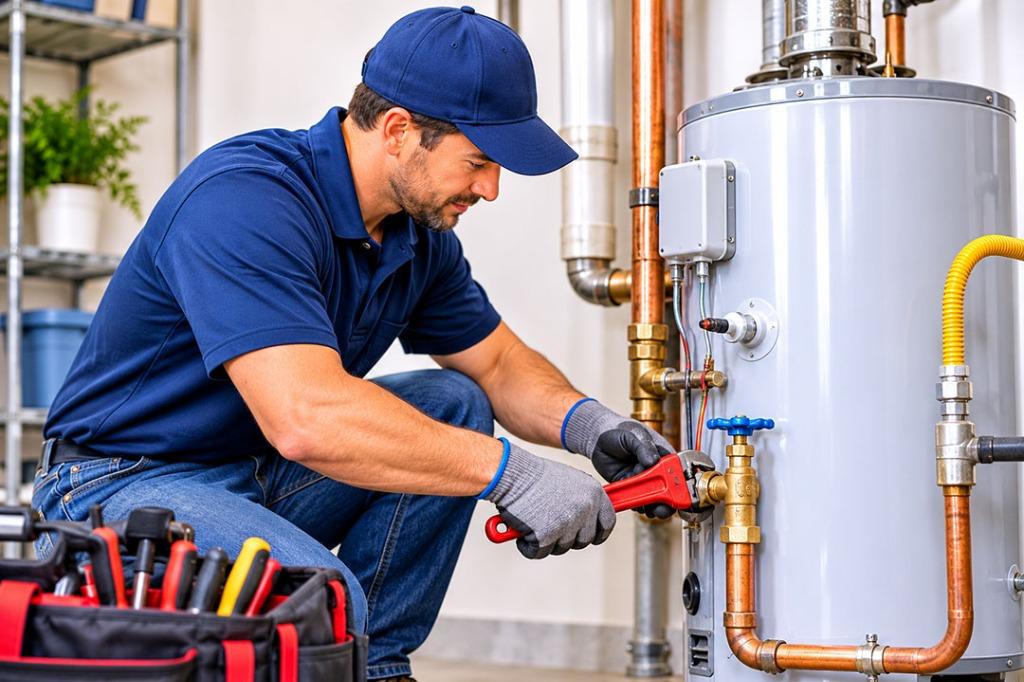
On-Site Field Testing & Diagnostic Standards
Denver plumbers verify water pressure, high-altitude gas combustion ratios, and electrical continuity before recommending part replacements. If you suspect your water heater is failing, call for an immediate on-site inspection.