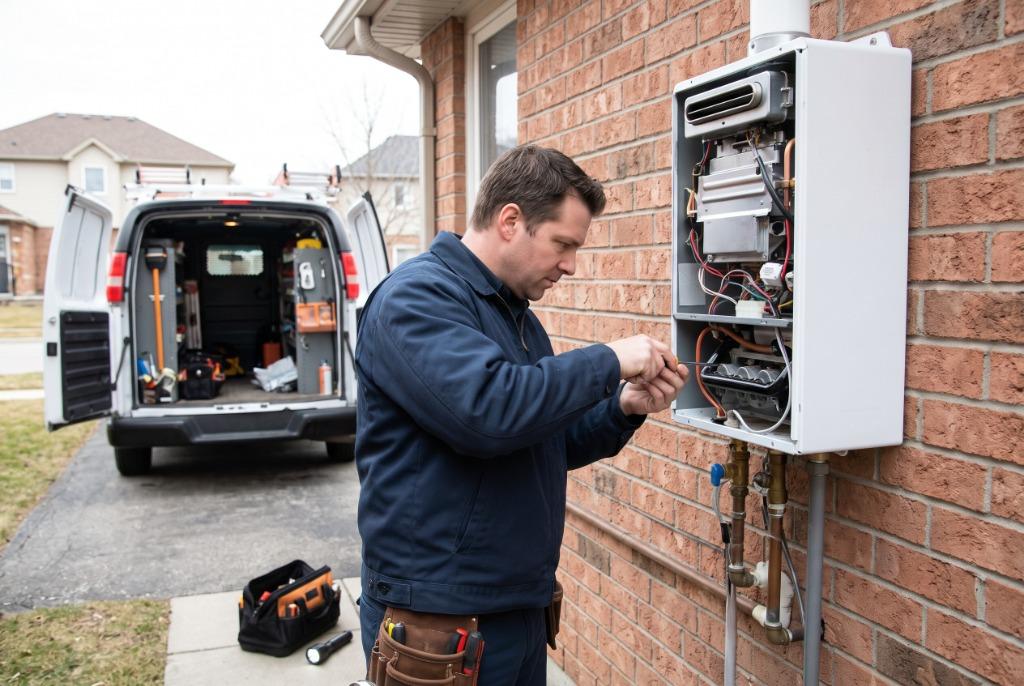
Commercial Hot Water Requirements for Denver Restaurants, Salons & Multi-Family
In a commercial setting, domestic hot water is not a luxury—it is a mandatory operational requirement governed by state, local, and public health codes. If a restaurant in LoDo or Cherry Creek loses hot water on a Friday night, the Denver Department of Public Health & Environment (DDPHE) can issue an immediate mandatory closure notice. If an apartment complex in [Aurora](/service-areas/aurora/) or [Lakewood](/service-areas/lakewood/) experiences an unaddressed boiler failure, property managers face severe habitability lawsuits.
Commercial water heating demands specialized sizing, strict temperature calibration, and proactive maintenance protocols far beyond standard residential applications.
In this guide, we review the critical plumbing codes, health inspection thresholds, Legionella prevention strategies, and redundancy systems that every Denver commercial facility manager must know.
Temperature Compliance by Industry
Different commercial operations require strictly regulated water delivery temperatures:
1. Restaurants & Food Service Establishments Under FDA Food Code and Denver City Health Regulations: - **Handwashing Sinks**: Must deliver water at least **100°F** within 20 seconds of tap activation. - **3-Compartment Dishwashing Sinks**: Washing compartment must maintain at least **110°F to 120°F** with detergent. - **High-Temperature Commercial Dishwashers**: Final sanitizing rinse cycle must reach at least **180°F** at the manifold (or 160°F on the dish surface) to sanitize without chemical additives.
2. Hair Salons, Spas & Barber Shops Regulated under Colorado Barber and Cosmetology Licensing Rules: - Continuous hot running water is mandatory at shampoo bowls (minimum **105°F to 115°F**). Interrupted service requires shutting down washing stations immediately.
3. Healthcare, Senior Living & Hotels - Must balance hot water delivery for resident comfort while protecting against life-threatening scald hazards for vulnerable populations.
The Great Dilemma: Legionella Bacteria vs. Scald Protection
Commercial property managers face an inherent engineering contradiction:
$$ ext{Legionella Danger Zone: } 68^circ ext{F to } 122^circ ext{F} quad ext{vs.} quad ext{Scald Threshold: } >125^circ ext{F}$$
*Legionella pneumophila*, the bacteria responsible for severe Legionnaires' disease pneumonia, thrives in warm, stagnant water: - **Below 68°F**: Bacteria is dormant. - **68°F to 122°F**: Optimal bacterial reproduction range. - **122°F to 131°F**: Bacteria survives, but reproduction stops. - **140°F (60°C)**: Bacteria is killed within 32 minutes. - **151°F (66°C)**: Bacteria dies within 2 minutes.
The Solution: High-Temperature Storage + ASSE 1017 Master Mixing Valves To comply with CDC and ASHRAE Guideline 12: 1. **Store Water Hot**: Commercial storage tanks and boilers maintain water at **140°F or higher** to completely eliminate bacterial colonization. 2. **Blend at the Point of Distribution**: A certified **ASSE 1017 thermostatic master mixing valve** is installed directly on the boiler discharge line. It blends incoming cold water with 140°F hot water, distributing safe **120°F water** into the general building piping to eliminate scalding hazards.
Recirculation Loops and Flow Dynamics
In commercial buildings with multi-story footprints (hotels, office complexes, multi-family housing), customers cannot wait 3 minutes for hot water to travel from a basement mechanical room to the 4th floor.
Plumbing codes mandate dedicated **hot water recirculation loops**: - A bronze or stainless steel circulating pump continuously moves hot water through building risers and back to the heater. - Balancing valves (circuit setters) ensure every floor receives equal flow pressure. - Recirculation loops must be fully insulated to maintain temperatures above 122°F throughout the loop, preventing stagnant bacterial dead-legs.
Redundancy Design: Eliminating Single Points of Failure
For mission-critical operations (busy restaurants, hotel kitchens, breweries), a single 100-gallon storage water heater is a massive liability. When that single tank fails, the business closes.
Modern commercial designs utilize **modular multi-unit tankless banks**: - Instead of one massive boiler, 3 to 6 high-efficiency condensing tankless units (such as Navien NPE-240S2 or Rinnai Sensei CX199) are manifolded together in parallel on an intelligent controller rack. - **Cascade Rotation**: The system rotates which unit fires first, distributing wear evenly. - **Built-in Redundancy**: If unit #2 requires maintenance or parts, the controller isolates it while units #1, #3, and #4 continue delivering hot water uninterrupted. Your kitchen never closes.
Learn more on our [Commercial Water Heater Repair](/commercial-water-heater-repair-denver/) page.
Commercial Preventive Maintenance Checklist
To avoid catastrophic business disruption, commercial water heaters should receive scheduled service quarterly or semi-annually:
| Inspection Task | Frequency | Purpose |
|---|---|---|
| Flush Bottom Sediment | Quarterly | Clears lime scale from high-BTU burner floors |
| Test ASSE Mixing Valve | Semi-Annually | Verifies temperature output to prevent scald lawsuits |
| Inspect Sacrificial Anodes | Annually | Preserves expensive commercial steel storage vessels |
| Inspect Recirculation Pump | Semi-Annually | Checks motor bearings, amperage draw, and check valves |
| Descale Tankless Exchangers | Semi-Annually | Restores flow rate and thermal efficiency |
| Combustion & Flue Gas Analysis | Annually | Measures CO levels and verifies altitude oxygen ratios |
Commercial Sizing Calculations: First Hour Rating (FHR) & Peak Demand
Sizing a commercial water heating system in Denver requires calculating concurrent fixture draw rates and recovery capacity:
$$ ext{Total Peak Demand} = ( ext{Dishwasher GPM} imes ext{Duration}) + ( ext{Prep Sinks GPM}) + ( ext{Restroom Sinks GPM})$$
For example, a high-volume restaurant in downtown Denver running an automatic conveyor dishwasher (consuming 60 gallons per hour at 180°F rinse), two hand sinks, a three-compartment pot sink, and prep stations requires a water heating plant capable of delivering at least **180 to 250 Gallons Per Hour (GPH) recovery** at an 80°F temperature rise.
Attempting to power this demand with a standard 75-gallon residential water heater leads to rapid thermal failure, cold dishwashing water, and failed municipal health inspections. Our commercial specialists calculate precise BTUs, recovery rates, and storage capacities tailored to your facility's exact fixture count.
Municipal Health Inspection Readiness Checklist for Denver Facilities
Before a Denver Department of Public Health & Environment (DDPHE) inspector enters your restaurant, salon, or childcare facility, verify the following water heating parameters:
- **Digital Thermometer Verification**: Measure water temperatures at hand sinks with a calibrated digital thermometer (minimum 100°F within 20 seconds).
- **Dishwasher Rinse Gauge Reading**: Ensure the commercial dishwasher's final rinse dial registers 180°F or higher during active wash cycles.
- **No Weeping Pressure Relief Valves**: Check that the commercial T&P relief valve discharge line terminates safely between 1 and 6 inches above an indirect waste drain receptor.
- **Current Backflow Prevention Certification**: Ensure backflow assemblies on commercial boiler feeds and dishwashers have passed their mandatory annual test and display certified inspection tags.
Emergency Commercial Dispatch Across Denver Metro
When hot water fails at your business, speed is everything. Our commercial plumbing network provides dedicated priority dispatch for restaurants, salons, property managers, and commercial facilities across Denver, Aurora, Lakewood, Arvada, and Westminster.
Call our commercial priority line at **(456) 789-0123** to connect directly with a licensed commercial plumbing specialist.
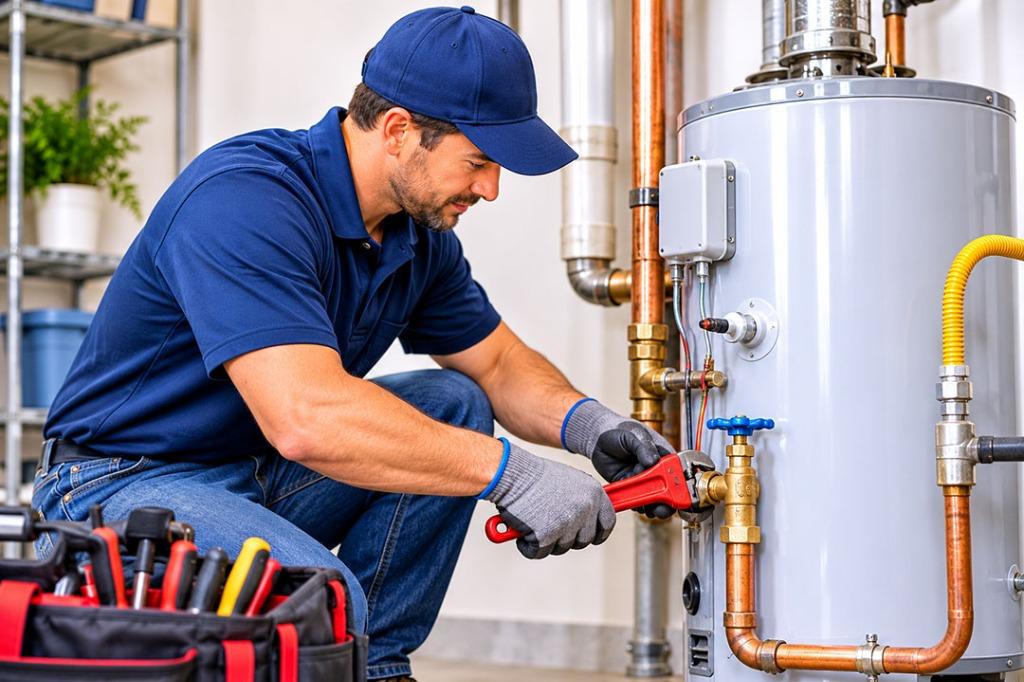
On-Site Field Testing & Diagnostic Standards
Denver plumbers verify water pressure, high-altitude gas combustion ratios, and electrical continuity before recommending part replacements. If you suspect your water heater is failing, call for an immediate on-site inspection.